
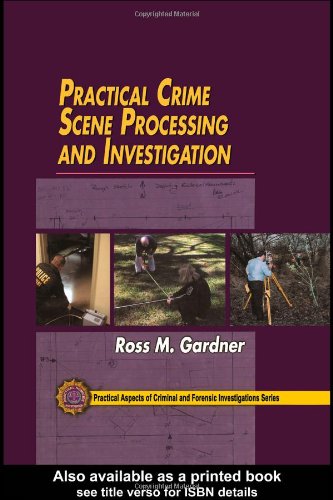
Practical crime scene processing and investigation / Ross M. Gardner.
Material type: TextSeries: CRC series in practical aspects of criminal and forensic investigationsPublication details: Boca Raton, Fla. : CRC Press, c2005.Description: xxiv, 391 p. : ill. (chiefly col.) 26 cmISBN:
 - 0849320437 (alk. paper)
- 9780849320439 (alk. paper)
- HV8073 .G32 2005
- W 860
| Item type | Current library | Home library | Call number | Status | |
|---|---|---|---|---|---|
 Books
Books
|
Dow Medical College | Dow Medical College | W 860 .G37 2005 (Browse shelf(Opens below)) | Available |
Includes bibliographical references and index.
Dedication -- Foreword / Eugene R. Cromartie -- Preface -- Acknowledgements -- About the author -- Editor's note -- 1. Introduction -- 2. Understanding the nature of physical evidence -- 3. Actions of the initial responding officer -- 4. Processing methodology -- 5. Assessing the scene -- 6. Crime scene photography -- 7. Crime scene sketching and mapping -- 8. Narrative descriptions : crime scene notes and reports -- 9. Basic skills for scene processing -- 10. Advanced techniques for scene processing -- 11. Special scene considerations -- 12. The role of crime scene analysis and reconstruction -- Appendix A. Crime scene equipment -- Appendix B. Risk management -- Index.
Every action performed by a crime scene investigator has an underlying purpose: to both recover evidence and capture scene context. It is imperative that crime scene investigators must understand their mandate--not only as an essential function of their job but because they have the immense responsibility and duty to do so. Practice Crime Scene Processing and Investigation, Third Edition provides the essential tools for what crime scene investigators need to know, what they need to do, and how to do it. As professionals, any investigator's master is the truth and only the truth. Professional ethics demands an absolute adherence to this mandate. When investigators can effectively seek, collect, and preserve information and evidence from the crime scene to the justice system--doing so without any agenda beyond seeking the truth-- not only are they carrying out the essential function and duty of their job, it also increases the likelihood that the ultimate goal of true justice will be served.--Publisher's description
There are no comments on this title.